Step 02 · Configure your build · 1U
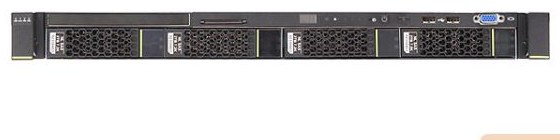
Huawei FusionServer RH1288 V3 chassis 4x3.5" (new)
Same RH1288 V3 platform as the 8×2.5" sibling, but with 4 × 3.5" LFF bays for high-capacity SATA storage. Best fit when raw capacity matters more than IOPS — backup targets, media stores, ZFS/TrueNAS file servers. You can mix 2.5" SSDs into the 3.5" bays via $20 caddy adapters (configurator handles this automatically).
Closest equivalents (other vendors)
| Dell | PowerEdge R430 / R630 (LFF) | 1U LFF dual-socket Haswell/Broadwell. |
| HPE | ProLiant DL360 Gen9 (LFF) | 1U with 4 × 3.5" bays. |
| Supermicro | SuperServer 5018A-MLTN4F | 1U LFF general-purpose. |
Spec sheet
| Form factor | 1U rack |
| Dimensions (W×D×H) | 436 mm × 708 mm × 43 mm |
| Weight (chassis only) | ≈ 12 kg (heavier than 8×SFF due to LFF backplane) |
| Sockets | 2× LGA 2011-3 (Socket R3) |
| Chipset | Intel C610 |
| Memory | 16× DDR4 RDIMM/LRDIMM, up to 1.0 TB at 2400 MT/s |
| Drive bays | 4 × 3.5" LFF hot-swap (also accepts 2.5" via caddy) |
| Storage controllers | SAS3 12 Gb/s HBA / RAID |
| RAID levels | 0, 1, 1E, 10, 5, 50, 6, 60 |
| PCIe expansion | 3 × PCIe Gen3 |
| Onboard NIC | FlexLOM mezzanine slot + optional PCIe NIC |
| Power supplies | 1+1 redundant CRPS |
| Cooling | 8× counter-rotating 1U fans |
| Operating temp | 5°C–40°C |
| Drives | 4 × 3.5" LFF native (Hitachi NL-SAS / SATA). Customer can also fit 2.5" SSDs using $20 caddy adapters; configurator auto-adds the right caddy count. |
Huawei power-management features
- Dynamic Power Capping (DPC) — set a wattage ceiling and the iBMC throttles CPUs when total draw approaches it.
- Power Saving Mode (PSM) — drops idle CPU C-states aggressively; ~5–8% lower idle wattage at the cost of 1–2 ms wakeup latency.
- Static Low-Power Mode — disables Turbo Boost and caps P-state for predictable thermals; useful in dense racks.
- Cooling Mode (Energy / Acoustic / Performance) — fan-speed curve presets via iBMC. Energy mode adds ~10°C to component temps but cuts fan power ~30%.
- Memory Sub-Throttling — keeps DIMM thermals in spec under high-density configs (24 DIMM slots populated) without dropping the whole channel.
- AC Restoration Policy — "power on after AC restore" (default), "stay off", or "restore last state". Configurable in BIOS or iBMC.
- Wake-on-LAN + iBMC remote power-on — bring the box up over the network without a deskside trip.
Management (iBMC)
- iBMC 2.0 — Huawei's baseboard management controller with web UI, redfish API, IPMI 2.0, and SNMP.
- KVM-over-IP via the iBMC port (HTML5, no Java).
- Predictive Failure Analysis (PFA) for DIMMs, CPUs, fans, PSUs.
- Hardware monitoring exposed via Redfish JSON API for Prometheus/Zabbix scraping.
- BIOS / firmware update via iBMC web UI or redfish; no booting from USB required.
Documentation
Frequently asked
Are Huawei servers banned in the US?
No, not for private commercial use. Two important facts up front: (1) the FusionServer V3 chassis we sell were manufactured and imported into the US before the 2019 Entity List restrictions took effect — they are pre-existing US inventory, not newly imported. (2) The 2019 Entity List limits *Huawei's ability to buy from US suppliers* — it doesn't stop US customers from owning, operating, or buying second-hand Huawei hardware that's already here. The narrower restrictions that DO exist apply to: (a) critical telecom infrastructure (FCC's 2020 rule on 5G base-station equipment), (b) federal procurement (NDAA Section 889 — federal agencies and federal contractors using covered telecom equipment), and (c) TAA-compliant procurement for federal contracts. If you're a private enterprise, a state/local entity not handling federal grants, a homelab, an MSP, or a non-US customer, you can run our FusionServer V3 kit without legal issue. We don't sell to federal contractors who would be in violation of §889.
What management interface do these use?
Huawei's iBMC (integrated Baseboard Management Controller) — equivalent to Dell's iDRAC or HPE's iLO. HTML5 KVM-over-IP, Redfish API, IPMI 2.0, SNMP. The iBMC port is dedicated and runs even when the host is powered off, so you can remotely turn the box on/off, reset BIOS, and view boot logs.
Do they support standard rails?
Yes. Unlike Dell or HPE — which use proprietary rail kits — Huawei V3 chassis mount with standard L-rails. Any generic 1U/2U L-rail kit you already have (or pick up cheap on eBay) will fit. We ship the chassis without rails to keep cost down; you supply your own.
Honest notes
- Noise: 1U chassis use 6 small high-RPM dual-rotor fans — typically ~60 dBA at idle and ~70 dBA under sustained load. We don't currently offer a low-noise upgrade kit for the 1U: the available 40mm replacement fans give up too much static pressure to cool a fully-loaded 1U under heavy CPU/IO work. If low ambient noise matters, the 2U RH2288 V3 (where our "quiet fan kit" upgrade is available) is the right pick.
Step 03 · Pick components
Configure your build
Heads up: component prices track live markets and refresh daily — the total you see now is the price you pay if you check out today. Lock it in by adding to cart; tomorrow's price could be higher or lower.
Huawei FusionServer RH1288 V3 chassis 4x3.5" (new)
CPU
One model, qty fixed at 2 (dual-socket).CPU pair
RAM
DDR4 ECC. 4 modules recommended (one per memory channel, balanced across both sockets). Minimum 2; max = chassis DIMM slot count. All modules must be the same SKU.RAM modules
Storage
Bay-native drives, NVMe AIC (1 per PCIe slot), caddies for SFF-in-LFF.SATA SSD
SATA HDD
NVMe AIC
2.5→3.5 caddies
PSU
1 or 2 PSUs. If 2, both must be the same model.Power supplies
Network
PCIe NICs use a slot each. FlexLOM is mezzanine, 1U-only. Skip only if you're supplying your own — otherwise the build ships without networking.PCIe NICs
FlexLOM (1U)
OS / boot
Choose one OS, a RAID layout, optionally a USB boot drive.Operating system
ⓘ Add a drive first — USB boot sticks chain to NVMe but aren't an OS install target.
Boot RAID
USB boot drive